Dental Case Acceptance: Why Good Patients Don't Move Forward With Treatment
A patient comes to your clinic with a genuine problem.
They attend the consultation. Your dentist identifies the problem. The treatment makes clinical sense. The patient seems interested.
Then they leave without booking.
A few days later, your team follows up.
No answer.
Another message goes out.
Still nothing.
Eventually, the patient becomes another unscheduled treatment plan in the CRM.
For many dental clinics, the immediate explanation is predictable:
“The treatment was too expensive.”
Sometimes that's true.
But often, the clinic is looking at the final moment of the decision while ignoring everything that happened before it.
Dental case acceptance isn't created when the patient is asked to book. It develops throughout the entire patient journey.
A patient can lose confidence during the first enquiry. They can become overwhelmed during the consultation. They can understand the procedure but fail to understand its value. They can leave with an unanswered fear. They can intend to proceed and simply receive the wrong follow-up at the wrong time.
The final “no” may only be the visible symptom.
The real problem may have started much earlier.
What Is Dental Case Acceptance?
Dental case acceptance generally describes the percentage of recommended or presented treatment that patients agree to proceed with.
A simple calculation might look like:
Case Acceptance Rate = (Accepted Cases ÷ Presented Cases) × 100
But there is an important complication.
Clinics don't always measure the same thing.
Some measure the number of treatment plans accepted. Others measure the monetary value accepted. Some count a case when the patient verbally agrees. Others count only scheduled treatment. Some measure same-day acceptance while others allow a longer decision window.
That is one reason published dental case-acceptance benchmarks vary considerably.
For your clinic, the most useful question therefore isn't simply:
“Is our case acceptance rate good?”
It is:
“Of the appropriate treatment we recommend, how much actually moves forward—and where are we losing the rest?”
That second question gives you something you can improve.
The Mistake: Treating Case Acceptance as a Single Event
A common model of dental case acceptance looks like this:
Diagnosis → Treatment presentation → Patient says yes or no
That model is too simple.
By the time a patient reaches the treatment presentation, dozens of smaller judgments may already have been made.
- Do I trust this clinic?
- Do they understand what matters to me?
- Is this treatment really necessary?
- Why does it cost this much?
- What happens if I wait?
- Will it hurt?
- What if something goes wrong?
- Are there alternatives?
- Am I being advised—or sold to?
- Can I afford this right now?
- Do I need to discuss this with someone?
Patients rarely announce every one of these thoughts.
Instead, uncertainty accumulates.
And eventually you hear:
The clinic hears an objection.
But the patient may be communicating unresolved uncertainty.
Case acceptance is therefore better understood as a journey, not a closing event.
The Selling Smiles Patient Conversion Journey™
A patient's movement from interest to treatment can be viewed across six stages:
1. Enquiry
A potential patient reaches out to your clinic.
The conversion process has already started.
Response time, tone, clarity and the quality of the first interaction begin shaping the patient's perception of the clinic before they ever meet the dentist.
2. Consultation
The patient attends the consultation and receives an assessment.
This is not simply a clinical information exchange.
The patient is also evaluating the people, environment, communication and credibility surrounding the recommendation.
3. Recommendation
The clinic presents the appropriate treatment and explains the available options.
Clinical accuracy is essential.
But clinical accuracy alone does not guarantee patient understanding.
4. Decision
The patient evaluates the recommendation against their needs, fears, priorities, finances, trust and perceived value.
This is where a clinically obvious decision can become psychologically difficult.
5. Commitment
The patient decides to proceed.
But even this is not the end.
Agreement without a clear next step can still turn into delay.
6. Scheduling
Treatment is booked and the patient moves forward.
Only now has intention become action.
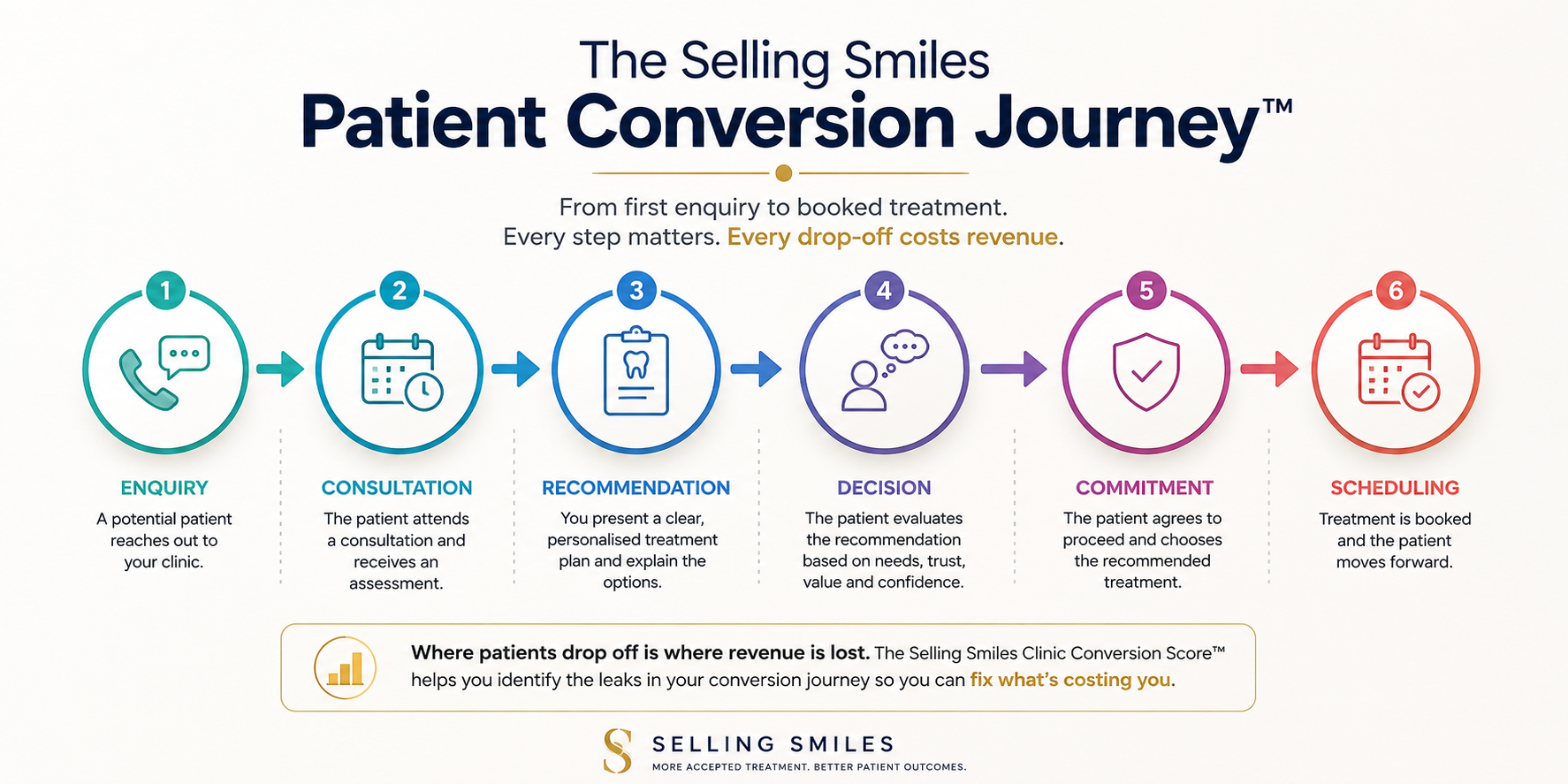
When clinics look only at the final booking rate, they compress this entire journey into one number.
That hides the real problem.
A clinic may have excellent dentists but weak enquiry handling.
Another may generate strong consultations but poor follow-up.
Another may communicate clearly but fail to uncover the emotional reason a patient is hesitating.
All three can produce the same visible outcome:
unscheduled treatment.
But they require completely different solutions.
Why Dental Patients Don't Accept Recommended Treatment
There is rarely one universal reason.
Several factors can interact within the same decision.
1. The patient understands the procedure—but not the value
Dental professionals naturally communicate through clinical information.
Patients don't necessarily make decisions that way.
Explaining implant dimensions, materials, bone levels, occlusion or technical stages may educate the patient without answering the question they actually care about:
“What will this change for me?”
Clinical information needs to be translated into personally relevant outcomes.
The goal isn't to hide clinical detail.
It is to connect that detail to what matters to the patient.
2. Trust has not developed enough for the size of the decision
Trust becomes especially important when treatment is expensive, invasive, elective or difficult for the patient to evaluate independently.
A patient may believe that your dentist is qualified and still not feel confident enough to proceed.
Those are different things.
This makes trust more than a “soft skill.”
It is part of the decision architecture.
3. The consultation answers the clinic's questions, not the patient's
A clinic needs clinical information.
But a high-quality consultation also needs human information.
- Why did the patient seek treatment now?
- What bothers them most?
- What are they worried about?
- What previous experiences have shaped their expectations?
- What outcome matters most?
- What would make them uncomfortable proceeding?
Without those answers, the clinic may present the correct treatment to a patient whose real decision criteria remain unknown.
4. Too much information creates uncertainty instead of clarity
More information does not automatically create more confidence.
Patients can receive photographs, scans, treatment options, technical explanations, timelines, prices, warranties and financing information—and still leave confused.
The objective of a consultation isn't maximum information transfer.
It is sufficient understanding for an informed decision.
When everything receives equal emphasis, the patient has to determine what matters on their own.
A strong consultation creates hierarchy:
- Here is the problem.
- Here is why it matters.
- Here are the appropriate options.
- Here is what I recommend and why.
- Here is what happens next.
Clarity reduces cognitive effort.
5. The clinic treats hesitation as an objection to defeat
A patient says:
“It's expensive.”
The team immediately starts defending the price.
But perhaps the patient could afford the treatment and simply isn't convinced of its value.
Or:
“I need to think about it.”
The team immediately offers a discount.
But perhaps the patient is frightened of surgery.
Or:
“I need to speak to my partner.”
The team interprets it as avoidance.
But perhaps another person genuinely participates in major financial decisions.
If the team responds to the sentence rather than the reason behind it, the conversation moves in the wrong direction.
The better question is:
What uncertainty is preventing this patient from making a confident decision?
The Five Dimensions Behind Dental Case Acceptance
At Selling Smiles, we evaluate conversion through five interconnected dimensions.
1. Patient Psychology
What is driving the patient's decision?
Motivation, fear, perceived risk, previous experiences, expectations and emotional priorities all influence how treatment is evaluated.
The same treatment can therefore require very different conversations with different patients.
2. Trust Building
Does the patient believe the recommendation is credible, appropriate and genuinely in their interest?
Trust is built through consistency, transparency, communication and the patient's experience across the clinic—not through one persuasive statement.
3. Consultation
Can the team transform clinical expertise into a conversation the patient can understand and use to make a decision?
A strong consultation creates clarity rather than information overload.
4. Follow-Up
What happens when the patient isn't ready today?
Many clinics have follow-up processes.
Fewer have follow-up strategies.
Repeatedly asking “Have you decided?” is not the same as helping someone resolve the reason they haven't decided.
5. Sales Performance
Can the team identify barriers, discuss value, handle concerns ethically and guide the patient toward an appropriate decision?
Ethical selling in healthcare is not about convincing every patient to buy.
It is about helping suitable patients make informed, confident decisions about appropriate care.
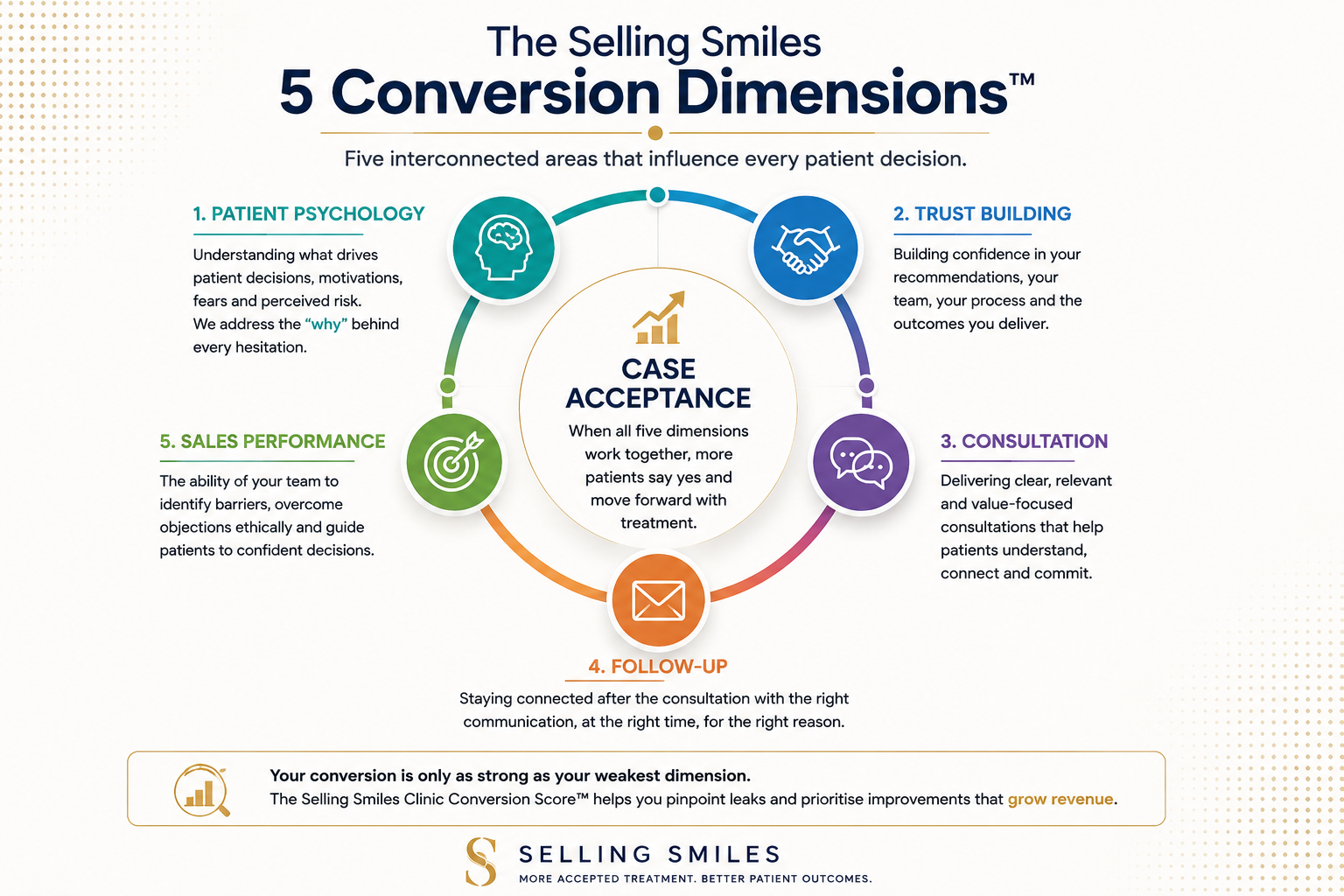
These dimensions are interconnected.
Weakness in one can reduce the effectiveness of the others.
A brilliant consultation cannot fully compensate for poor trust.
Excellent follow-up cannot repair every badly handled consultation.
Strong sales skills should not compensate for inappropriate treatment recommendations.
Your conversion system is only as strong as the weakest critical part of the patient journey.
“I Need to Think About It” Is Data
One of the most useful mindset changes a clinic can make is to stop treating hesitation as failure.
Hesitation contains information.
When a patient says they need to think, the objective shouldn't be to pressure them into an immediate yes.
The objective is to understand what remains unresolved.
You might ask:
“Of course. Before you go, is there anything in particular you're still uncertain about—the treatment itself, timing, cost, or something else?”
That gives the patient permission to reveal the real barrier.
Sometimes the answer will genuinely be money.
Sometimes fear.
Sometimes timing.
Sometimes trust.
Sometimes another decision-maker.
And sometimes the patient simply isn't ready.
That is okay.
Good case acceptance is not 100% acceptance.
The objective is not to maximize pressure.
The objective is to minimize avoidable loss of appropriate treatment caused by poor communication, weak trust, unclear value or broken follow-up.
Better Case Acceptance Starts With Better Diagnosis—of Your Conversion System
When case acceptance is low, clinics often jump immediately to solutions:
- Train the treatment coordinator.
- Change the script.
- Offer financing.
- Send more follow-ups.
- Discount the treatment.
- Generate more leads.
Some of those actions may help.
But implementing a solution before identifying the leak is guesswork.
Imagine two clinics both converting 45% of presented treatment.
Clinic A has excellent consultations but almost no systematic follow-up.
Clinic B follows up consistently, but patients leave consultations confused about why treatment is necessary.
Same KPI.
Different problem.
Different solution.
Before asking:
“How do we increase case acceptance?”
Ask:
“Where does our conversion system break down?”
Seven Questions to Ask Inside Your Clinic
- How quickly and effectively do we respond to new enquiries?
- Do we understand what matters to the patient before presenting treatment?
- Can patients explain their recommended treatment back to us in simple language?
- Do we systematically identify unresolved fears or concerns?
- Does the patient clearly understand why the recommended treatment matters to them?
- What happens when a patient leaves without scheduling?
- Do we measure where patients disappear—or only total case acceptance?
The answers will tell you more than another generic sales script.
How to Improve Dental Case Acceptance Without Becoming Pushy
There is an important ethical distinction between persuasion and pressure.
Pressure tries to obtain the clinic's preferred answer.
Patient-centered persuasion helps someone evaluate an appropriate recommendation clearly.
That means:
- Understand before presenting.
- Ask before assuming.
- Translate rather than overwhelm.
- Connect treatment to patient priorities.
- Make costs transparent.
- Give appropriate choices.
- Address uncertainty without creating fear.
- Follow up with relevance rather than repetition.
- Respect a legitimate no.
The aim isn't:
“How can we make this patient say yes?”
A better question is:
“What does this patient need in order to make a confident, informed decision?”
That approach isn't opposed to commercial performance.
It is the foundation of sustainable commercial performance in healthcare.
You May Not Need More Leads
When growth slows, marketing is an obvious target.
- More ads.
- More enquiries.
- More consultations.
- More traffic.
But if qualified patients are disappearing between enquiry and consultation, consultation and recommendation, recommendation and commitment, or commitment and scheduling, increasing traffic simply pours more patients into the same leaking system.
Acquisition matters.
Conversion matters too.
Before increasing your marketing budget, understand what happens to the opportunities you already generate.
That is why we created the Selling Smiles Clinic Conversion Score™.
It evaluates five areas of your patient-conversion process:
- Patient Psychology
- Trust Building
- Consultation
- Follow-Up
- Sales Performance
The assessment takes approximately four minutes and helps identify where your clinic's conversion process may be weakest.
Where Is Your Patient Journey Losing Momentum?
You don't necessarily need more leads.
You may need to convert more of the right patients you already have.
Frequently Asked Questions
What is dental case acceptance?
Dental case acceptance measures how much recommended or presented dental treatment patients agree to proceed with. Clinics may calculate it by number of cases, treatment value, scheduled treatment or completed treatment, so the measurement method should remain consistent.
What is a good dental case acceptance rate?
There is no universally accepted benchmark that applies equally to every dental practice. Published ranges vary according to treatment type, whether cases or treatment value are measured, and when acceptance is counted. The most useful approach is to define your clinic's methodology consistently, establish a baseline and track improvement over time.
Why do dental patients reject treatment plans?
Price can be a factor, but patients may also hesitate because of fear, low perceived value, insufficient trust, confusing information, timing, uncertainty about treatment, previous experiences or the need to involve someone else in the decision.
How can a dental clinic improve case acceptance?
Start by identifying where patients disengage. Evaluate enquiry handling, patient psychology, trust building, consultation quality, treatment communication, follow-up and the team's ability to uncover unresolved concerns. Improving the weakest part of the journey can be more effective than applying the same sales technique everywhere.
Is improving dental case acceptance the same as selling harder?
No. Effective case acceptance should support informed patient decision-making. The goal is not to convince every patient to accept treatment, but to prevent appropriate care from being unnecessarily rejected because of confusion, weak communication, insufficient trust or unresolved concerns.
See Where Your Clinic Is Losing Momentum
Take the 4-minute Selling Smiles Clinic Conversion Score™ to identify your biggest conversion opportunities.